

(Jose Herman Salazar (left) and Simon Brown & Merlith Cruz's farm, Las Etíopes (right))
By Rachel Beebe
The exciting thing about working in specialty coffee is that things are constantly evolving and we love being able to share that with our customers. Our latest Discovery Set does just that by pairing two coffees that at first glance might not seem related: a Peruvian inoculated natural processed Heirloom variety grown by the husband and wife producer/importer duo Simon Brown and Merlith Cruz; and a Colombian washed process Aji variety grown by Jose Herman Salazar. That’s a mouthful, but what it means is that these coffees were grown in different countries, by different people, they’re different types of coffee plant and they were processed in different ways. So why have we put them together? In a word: genetics.
Jose Herman Salazar's farm
Both of these coffees are genetically Ethiopian but were grown in South America. We’ve seen this before with Panama Gesha and Colombian Pink Bourbon, and these two coffees are no less exceptional. To unpack this set we need to take a look at the coffee varieties family tree.
Cafe Imports: Coffee Family Tree
This beautiful graphic by Cafe Imports (linked here Cafe_Imports_Coffee_Family_Tree_isolated.png (3000×1645)) shows that almost all Arabica has just two parent varieties: Typica and Bourbon (shown in blue, yellow and pink in the graphic), and Bourbon is a genetic mutation of Typica. Most of the coffee we consume today has one of these two as its parent variety, and most of it has been bred to increase yield or disease resistance.
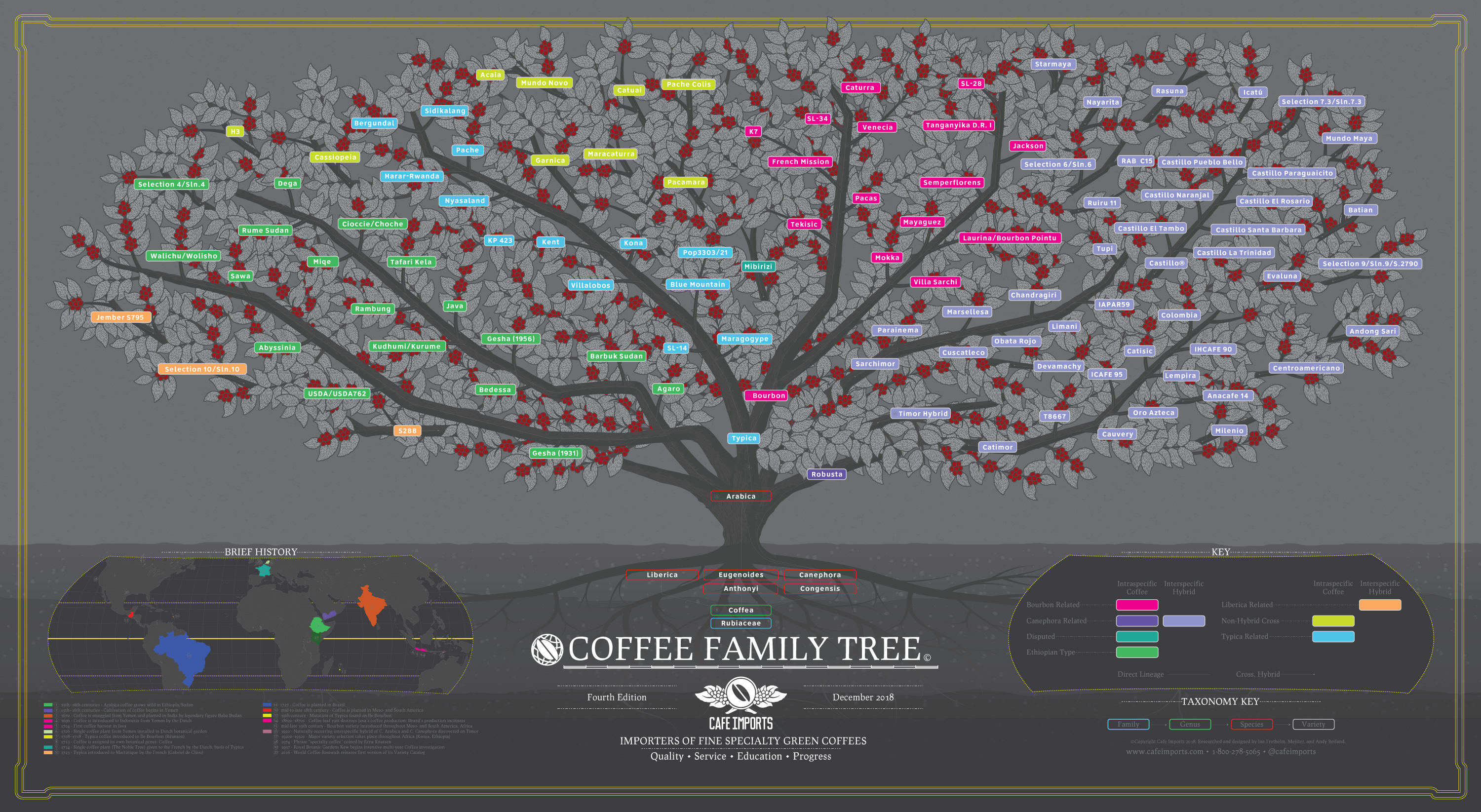
But the family of Arabica known as Ethiopian landrace varieties belong to an entirely different branch of the tree (shown in green on the graphic). They are varieties that can be traced back to the wild plants that grow in Ethiopia, where coffee originated. The only other branches, the orange on the far left and the purple on the far right, are hybrids between Arabica and other species of coffee, Liberica and Robusta, respectively.
In the same way that Braeburn apples taste different to Pink Lady, varieties of coffee taste different to one another, especially coffee from different branches of the genetic family tree. So, even though technically the two coffees in our Discovery Set are Peruvian and Colombian, they don’t taste like typical coffee from those origins. They both have flavour elements identifiable as Ethiopian.
The Peru, grown by Simon Brown and Merlith Cruz on their farm Las Etiopes, especially tastes like Ethiopian coffee. It’s a straight-up Ethiopian heirloom variety, and the processing method heightens these characteristic flavours. It’s super aromatic with floral notes of Jasmine, spice notes of cardamom and fruit notes of blueberry jam. The Colombian has a bit more of a blended flavour profile, with expressive citrus acidity you might associate with Colombia alongside blackcurrant, caramel and Biscoff.
These coffees are both delicious and as you enjoy sipping them it might be worth asking, how much of a coffee’s flavour comes from where it was grown—its terroir—and how much comes from its genetics?
You can pick up the set in our cafe or online (£20 for 2x125g bags).
For further reading:
• Curious Channel made a fantastic video all about coffee varieties which you can check out here - Coffee Varieties: Arabica. It’s a great introduction to the differences in varieties and their impact on your cup.
• We also wrote about ‘nature or nurture’ in coffee flavour last year on our blog, where we considered how discussions around flavour in coffee can converge with trust, control and power. You can check out that blog post here - Nature or Nurture: Where Coffee Gets its Flavour.