

Steampunk Coffee Roasters
Burundi Masenga Hill
Burundi Masenga Hill
Couldn't load pickup availability
Region: Bujumbura
Altitude: 1,700 m.a.s.l.
Variety: Red Bourbon
Processing: Washed
UK Arrival: April 2026
Tasting Notes: Generously fruity, led by vibrant cherry and raspberry, layered with florals and vanilla notes. A white sugar sweetness balances complex single-origin chocolate, all carried by a smooth, buttery body.
After cupping through samples from Burundi this year we couldn’t pick just one so we bought both this washed process lot and a natural process lot. It’s a great opportunity to taste both processing methods side-by-side and discover their impact on the final cup. Here you’ll find layers of florals, well structured fruitiness and high sweetness. This lot turns out to be a favourite of Zephryn, a Q grader in charge of quality control in Migoti, who is a good friend of Ludwika from when she worked alongside him a few years ago.
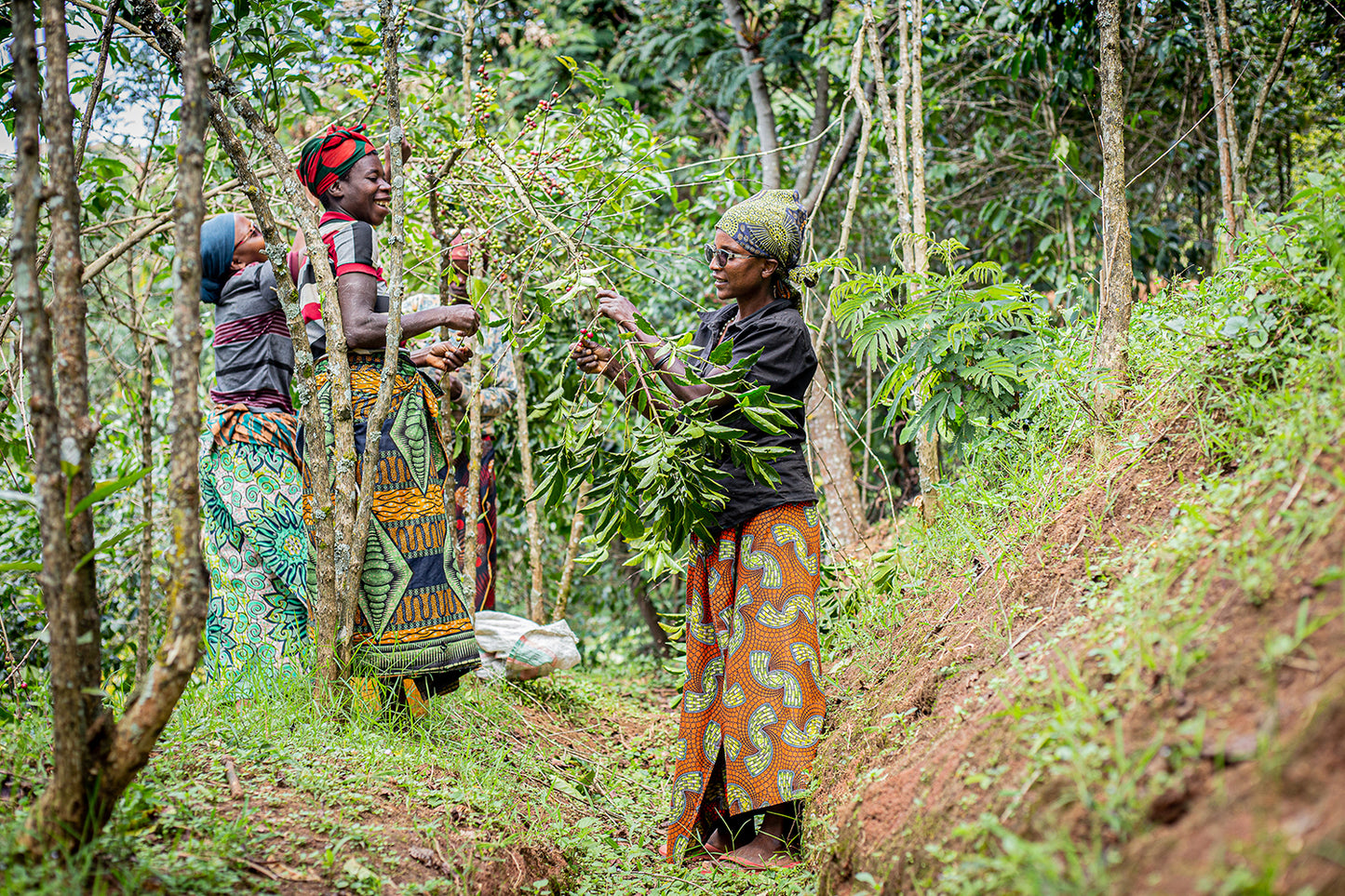
Eighty-one smallholders contributed to this lot, including lead farmers Damien Baransamaje and Ernest Habonimana. After harvesting, the farmers sold their cherries to Migoti Hill Coffee Company, who processed them at their washing station. Here, the coffee cherries were sorted, fermented for 24 hours, then pulped and washed. Next, the coffee was pre-dried on tables in the shade for five days, before being moved into the sun to dry fully on raised beds, which takes two to three weeks.
This coffee was brought to us by Omwani Coffee Company, who we recently interviewed in our Importer Series. We’ve been buying from Omwani since we first met in 2019, and have been endlessly impressed by both their commitment to their producer partners and the high quality coffee that they import.
About Migoti
Founded in 2015 by engineers Pontien Ntunzwenimana and Dan Brose, Migoti Coffee aims to improve the livelihoods of local coffee farmers by connecting them with international buyers and roasters through quality processing and transparent supply chains. The company operates two coffee washing stations, Kinama Hill and Migoti Hill, nestled in the mountains of the Bujumbura Rural Province and works with a growing number of smallholder farmers to produce high quality coffee.
Prior to 2015, the multi-generational coffee farmers in Pontien’s home community had all but abandoned coffee as a source of income due to the 12-year civil war, during which their Arabica coffee trees were neglected and destroyed. Another challenge was the great distance between their small farms and washing stations, which meant farmers had to dry coffee naturally on their farms. Their lack of equipment and training in quality control meant that the coffee they produced lost a lot of value. Crucially, they also didn’t have access to the specialty market, where the true value of their coffee could be realised.
Today, Migoti has 10 full time employees and hires an additional 250 seasonal workers to manage the busy harvest period. They’re assigned into teams that manage the different stages of processing:
Cherry collection, where cherries are weighed, floated, and grouped together depending on grade and the hill they come from;
Pulping, where floated cherries are run through the pulping machines. Fermentation, where cherries are separated into vats and left to ferment for different periods of time according to what process their lot has been assigned;
Washing, where fermented coffee gets pushed through the grading channels and its mucilage rinsed away;
Pre-drying, where coffee is spread out to dry in the shade for 2 to 3 days while being rigorously sorted;
Main drying, where coffee is laid out to dry under the sun, getting covered at night or when rain is due. Teams here carry out further sorting while turning the coffee regularly;
Quality control, where coffee gets cupped on a regular basis, checking that every lot is up to standards. An extra group is also stationed at the dry mill Migoti uses. These team members oversee Migoti’s coffee as it is hulled and sorted again before being bagged for export.
In order to make sure the farmers they work with are harvesting from the best quality trees, Migoti distributes seedlings that they have cultivated themselves. Over the last year, Migoti have planted another 44,208 coffee seedlings, raising the cumulative number of trees they have planted since operations began to over 350,000.
Migoti also offers microfinancing to the farmers they’ve worked with year-on-year. Coffee isn’t a reliable cash crop because in most places there is only one harvest each year, which means farmers only get paid only once per year. Often, farmers who need money between harvests are exploited by traders offering advance payments. These advance payments are much lower than what farmers would receive if they could afford to allow the coffee to ripen fully, employ careful picking and then sell to a washing station with a connection to the specialty market. By offering small loans, Migoti are enabling farmers to access money before the harvest season, then pay it back once they have sold their coffee for its true value.
This harvest year saw an unprecedented increase in the amount Migoti paid farmers for their crop, with pay-out for cherries being over twice what it was in 2024. This reflects the similarly dramatic rise seen in the C price over the last year, which increased by 30%. But it was also due to record high inflation in Burundi, which peaked in April 2025, at 45.5%.
Producer-Led Project Update
Steampunk will donate £1 from the sale of each bag of this coffee to the Kinama Renewable Water Distribution project. Migoti has been working on the project for the past couple of years. With his background in engineering, Pontien Ntunzwenimana has been leading the construction of a water reservoir and distributor for the use of the community in Kinama, where one of Migoti’s washing stations is based.
Once the pump and piping is fitted, the water system will feed clean water into both Migoti’s washing station and several water points within Kinama, including the local school. What’s particularly exciting about the water system is its self-powered hydraulic ram pump, which uses the pressure of water moving down a slope to propel and distribute it. If Pontien and the team can demonstrate that this set up is viable, they will have a model that can be repeated across other regions.
Kinama residents currently walk up to 2 km daily to access water, a task typically carried out by children and women. Access to clean water is a basic human right that will significantly reduce waterborne illnesses, lower infant mortality, increase time available for education and create opportunities for economic productivity.
Variety
Almost all of the coffee grown in Burundi is Red Bourbon. The specificity of this variety, along with the unique terroir of the mountains, lends coffees from Burundi a trademark flavour profile with a distinctively bright, juicy acidity and floral character.
Coffee has a biennial cycle of harvests, which means that during one season coffee trees will produce an abundance of cherries, and the following season they will produce much fewer. The last four years, however, have seen the margins between high-yield and low-yield seasons drawing ever smaller, and this year's low-yield crop came close in quantity to 2024’s supposedly high-yield harvest. That harvest was small due to climate change-related changes to weather patterns in the form of unexpectedly heavy rains during the flowering period.
Country
Burundi is the world’s poorest country, according to the World Bank. “Civil wars, political assassinations, ethnic violence, coups d’état, insurgencies, corruption and venal rulers have kept tiny Burundi — a former German and Belgian colony — stuck at the bottom of the world’s poverty rankings for two decades,” wrote the Financial Times last October.
Coffee is a major part of Burundi’s economy. According to the 2018 edition of the World Atlas of Coffee, coffee and tea exports together accounted for about 90% of the country’s foreign exchange earnings. There are no coffee estates; all coffee is grown by smallholder farmers. Approximately 800,000 families country-wide cultivate an average of 150 - 200 coffee trees per farm. This arrangement is a legacy of Belgian colonial rule. In the 1930s every peasant farmer was required to cultivate at least 50 coffee trees.
Like its neighbour, Rwanda, Burundi has ideal conditions for coffee production with elevations of 1,500 - 2,000 m.a.s.l. and abundant rainfall. Also like Rwanda, Burundi is landlocked, meaning that exporters face significant hurdles getting the harvest to port. This is especially the case in Burundi, where there has been a years-long fuel shortage and record inflation affecting the cost of transport.
For around five years now, Burundi has been dealing with a severe fuel shortage which has impacted the entire nation. Petrol is distributed in rations, leaving many unable to get to work or school. Even public transport doesn’t have enough fuel to operate, with timetables greatly reduced if not cancelled altogether. Where the official market falls short, a black market has emerged, selling fuel for roughly four times the price of standard sourcing channels. Smugglers are acquiring their stock from neighbouring Tanzania and Democratic Republic of Congo, risking prison or even death as they cross rivers and dodge border security.
At the time of this writing (May 2026), with fuel prices soaring because of the war in Iran just as the harvest is ready to be picked and processed, things are looking even more strained for farmers, washing stations and exporters.
A note about packaging
Our coffee comes packaged in beautiful and hard wearing tins. It is important to keep those beans away from air and light (see our blog post about coffee storage) and we think tins are the very best way of keeping those guys fresh.
Tins can of course be easily recycled (with other metals) but the very best and most environmentally conscious thing to do with them is to refill them. Find out how to refill or dispose of your Steampunk packaging HERE.
Share