

Steampunk Coffee Roasters
Honduras Carlos Alberto Portillo
Honduras Carlos Alberto Portillo
Couldn't load pickup availability
Region: El Cielito
Altitude: 1450 m.a.s.l.
Variety: Parainema
Processing: Washed
UK Arrival: December 2025
Tasting Notes: A layered coffee with top notes of jasmine florals, bright green and red apple acidity, maple syrup sweetness and hazelnut in the finish.
This is the third coffee we’ve bought through Langdon Coffee Merchants since we were first impressed by their Honduran lots a few years ago. Before that time we hadn’t bought much Honduran coffee because we couldn’t find the quality we were looking for. The coffee is excellent, but we also like their ethos, working with farmers long-term to build strong relationships.
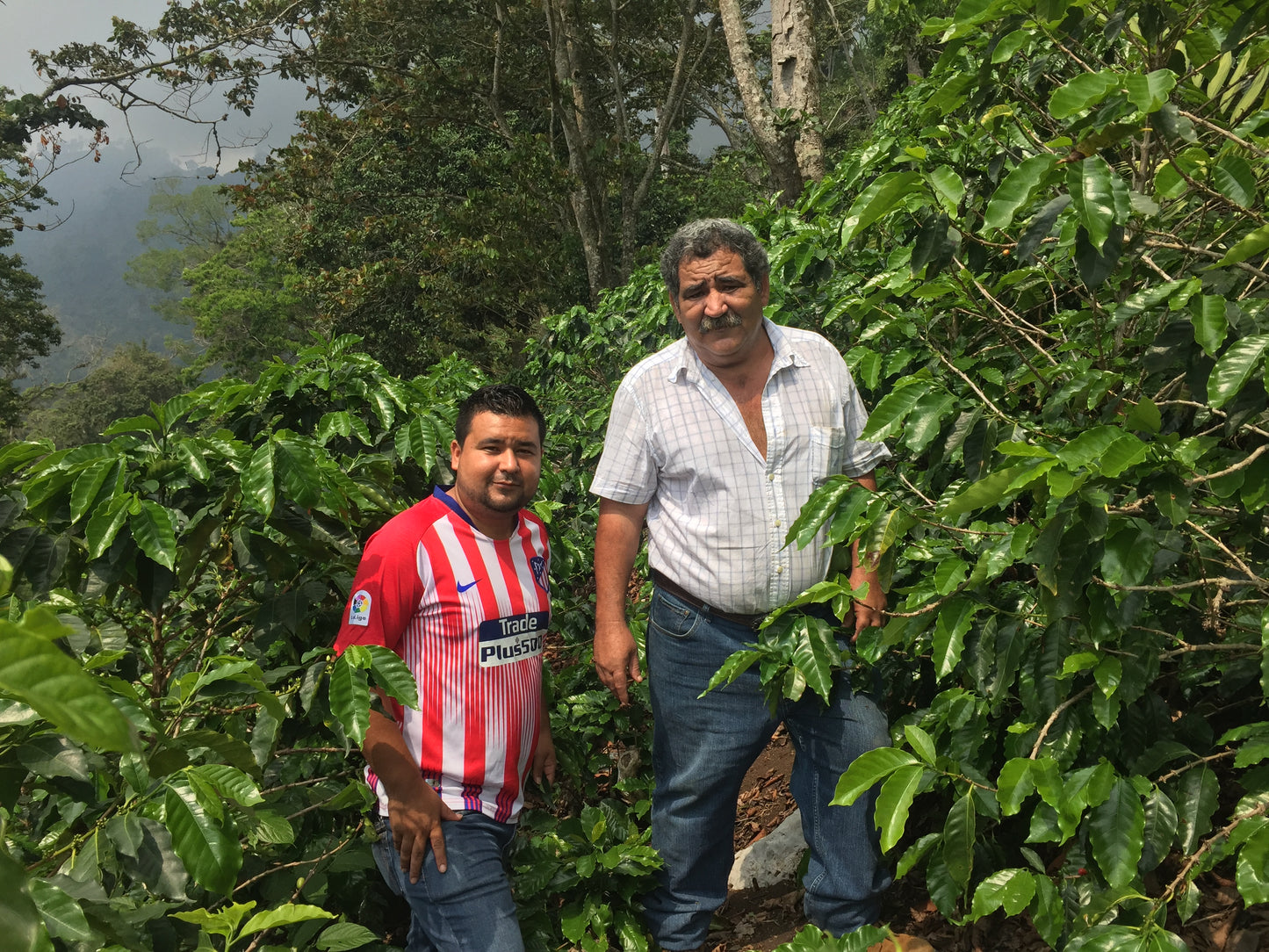
This washed process Parainema variety coffee was grown by Carlos Alberto Portillo on his family farm, Finca Don Pancho, which is just over 3 hectares and sits at 1,450 m.a.s.l. The harvest lasts from December to April, with shipments usually reaching the UK from autumn to winter time.
Portillo explains that the cherries are carefully picked and then de-pulped every afternoon. Then the beans are put into fermentation tanks where they are dry fermented (without additional water) for 15 hours. After fermentation the beans, called parchment at this stage, are rinsed with a lot of water four times. Next, they’re put inside a parabolic solar dryer for around 10 to 15 days. During this period the parchment is picked over by hand to remove defective beans.
Producer
Langdon Coffee Merchants has purchased from Portillo and his family for four years, and much has changed in that time. He’s a third generation coffee producer; his grandfather planted the first Bourbon seedling on his farm more than 40 years ago and over the years his father bought additional land and continued improving the plantation.
Portillo worked on the family farm with his father when he was young and while studying at university. In 2012 he graduated from university and began working in a textile factory to earn money while his father continued to run the farm. When Portillo turned 22 his father gave him part of the farm and in 2021, for the first time, he prepared his own microlot for export.
That same year he made the tough decision to leave for the United States due to economic problems and lack of capital to invest in his farm. Today he is still in charge of the expenses of the farm while his father Roberto Portillo manages harvesting and processing the coffee. Finca Don Pancho is planted with just over half Gesha and the rest Parainema.
Portillo says that the biggest challenges he faces are the cost of agricultural inputs, like fertiliser and the scarcity of labour. Like Portillo himself, many young Hondurans have emigrated to the United States, so it’s hard to find pickers at harvest time. In time Portillo plans to return to Honduras and hopes to be economically stable enough through coffee production to live comfortably. On the farm, the next step for improvement is to build another solar dryer.
Variety
Parainema beans are distinctive for their long, thin shape, and although the plant itself is a dwarf, the beans are relatively large. It was developed by the Honduran national institute of coffee (Instituto Hondureño del Café, IHCAFE) and released in 2004. World Coffee Research evaluated the yield and rust resistance at 23 sites in 15 countries as part of their International Multilocation Variety Trial and found that it has very high yields and is highly resistant to leaf rust.
Genetically it’s part of the Sarchimor group, which isn’t itself a district variety, but a group of many varieties all developed from similar parentage in different places in an effort to combat coffee leaf rust. In the cup, the acidity is bright, tending towards citrus. It can be very complex and sometimes has a herbal note that could be described as lemongrass or lemon verbena. The last Honduran Parainema Steampunk roasted was grown on Finca Los Cedros by Nury Melania Martinez in 2022. It’s been a while, but we’re excited to have another crack at this unique variety.
Country
Honduras is a small country geographically, yet it’s one of the largest producers of Arabica in the world. Honduras has quickly become the single largest producer of the commodity in Central America, rivalling neighbors Guatemala, El Salvador and Nicaragua in seasonal production and competing with Ethiopia in regards to volume produced. With over 120,000 coffee farms, coffee is Honduras’s main agricultural export crop.
The origin produces only Arabica coffee, but historically they’ve been known for lower quality commercial grade, not specialty grade. Today however, the country produces a wide range of qualities, from commercial to specialty, and within specialty the processing methods and flavour profiles are wide ranging, from tropical juicy anaerobic naturals to clean bright washed coffees.
Despite general political and economic instability (nearly 80 percent of rural Hondurans live in poverty, according to Human Rights Watch) Honduras has one of the most organized coffee sectors in Central America. Contributing to their success is significant backing from local governments in recent years, providing new resources and infrastructure to farmers. Honduras’s national coffee institute, IHCAFE, has established regional laboratories to grade and test coffee quality. They aim to focus on refining the potential of specialty lots from remote areas.
Importer
Langdon Coffee Merchants is a specialty coffee importer founded in Melbourne in 2015 by Chris Langdon as an offshoot of his family’s food importing business, Langdon Ingredients. They have since expanded and have offices in New Zealand and London, but the team remains small and their focus is on building long term relationships with producers. They import coffee from around Central America, Mexico, Africa and Papua New Guinea, but we’ve been particularly impressed with their Honduran coffees, which Ludwika first tasted a few years back at a local cupping event.
A note about packaging
Our coffee comes packaged in beautiful and hard-wearing tins. It is important to keep those beans away from air and light (see our blog post about coffee storage) and we think tins are the very best way of keeping those guys fresh.
Tins can of course be easily recycled (with other metals) but the very best and most environmentally conscious thing to do with them is to refill them. Find out how to refill or dispose of your Steampunk packaging HERE.
Share