

Steampunk Coffee Roasters
India Zuheb Abrar
India Zuheb Abrar
Couldn't load pickup availability
Region: Baba Budan Giri
Altitude: 1300 m.a.s.l.
Variety: S795
Processing: Natural
UK Arrival: October 2025
Tasting Notes: Prune and marmalade fruitiness alongside citrus and apple, underpinned by warm baking spices and dark brown sugar. Overall well-balanced and clean.
India is one of the oldest high-volume coffee origins, though many people don’t realise it because most of its production is Robusta, Arabica’s lower-growing, higher-yielding cousin. Legend says coffee arrived in 1670 with the pilgrim Baba Budan, and the region where he planted it still carries his name. Today, India is the world’s seventh-largest coffee exporter, and as climate and markets shift, more of its production is specialty Arabica.
Producer
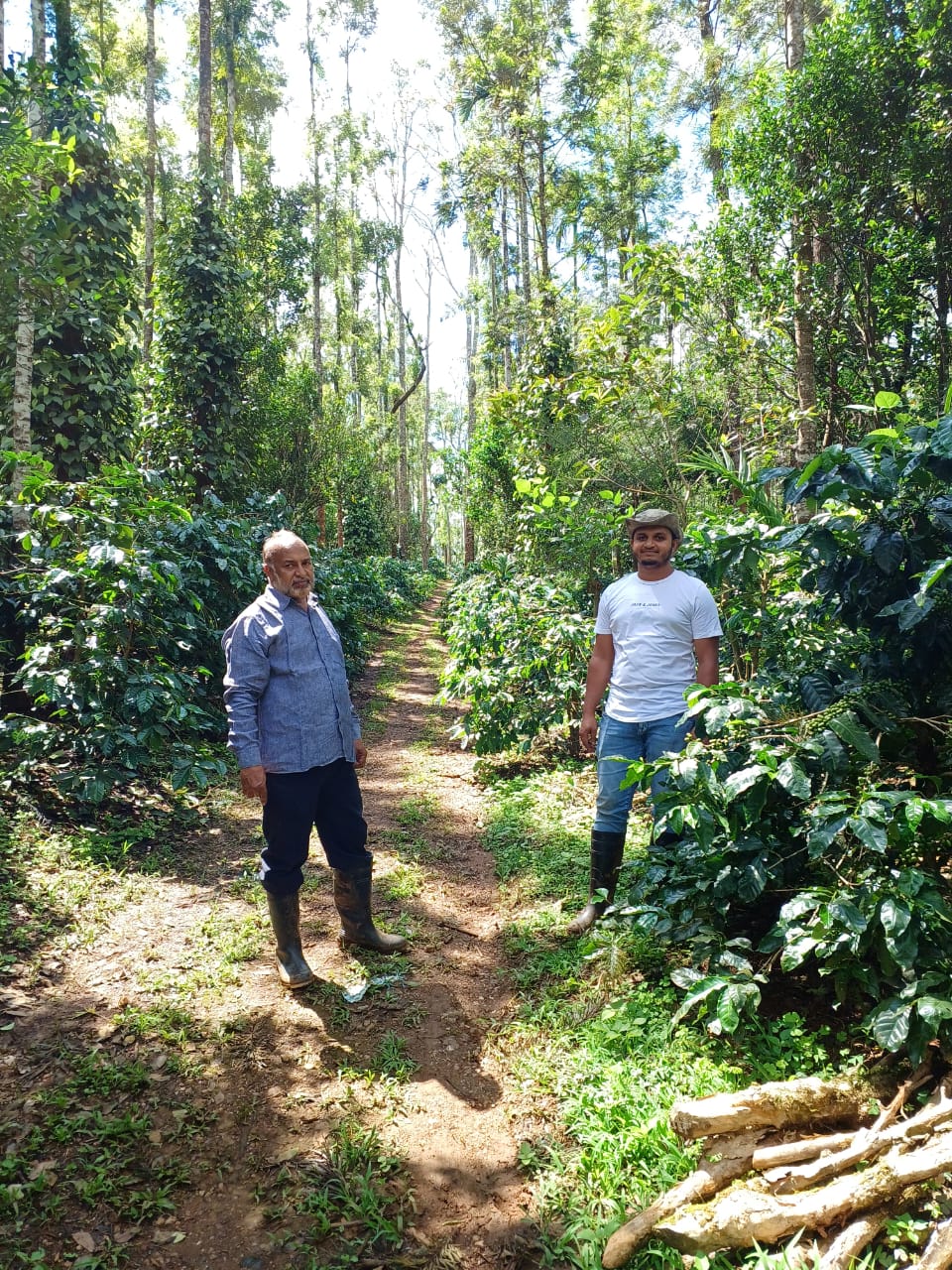
This coffee was grown on Zuheb Abrar’s 12-hectare Hospura Estate in the Western Ghats. Abrar studies civil engineering, but decided he would rather work in coffee and try to develop Hospura Estate’s potential as a wildlife sanctuary. The area is a UNESCO World Heritage Site, and wildlife conservation and specialty coffee farming are uniquely linked here, in contrast to many other coffee growing regions around the world where the crop is grown in monoculture.
Abrar is part of a farmer partnership called ReapAcres whose KaadKaapi program helps farmers achieve long-term environmental and economic sustainability. Kaadkaapi means “forest coffee” in Kannada, the language of Karnataka state in India. Traditionally, Indian coffee has been grown under shade, which distinguishes it from many sun-grown coffee systems globally. KaadKaapi carries on this tradition and champions an approach to cultivation that directly contributes to wildlife conservation, which is especially important in a region of such rich biodiversity.
KaapKaapi farmers agree to preserve the habitat of wildlife living on their land by maintaining dense canopy cover and native tree species. Farmers agree not to hunt or trap animals on their land and restrict "shade lopping" to specific times, avoiding bird nesting seasons. They also commit to using only permitted agro-chemicals. And they recognise private land as crucial wildlife corridors, allowing the free passage of large animals, even though this can sometimes cause damage to crops and infrastructure. In addition, many farmers within the KaadKaapi group volunteer with local and global wildlife conservation organizations and state forest departments, using these experiences to refine wildlife-friendly cultivation practices. They engage in science-based conservation activities, landscape protection (advocacy, legal intervention, policy, law enforcement), and monitoring of species and natural ecosystems.
Growing coffee under dense shade cover sharply decreases coffee’s crop yield and there are higher input costs associated with farming in an eco-friendly way. The premise of the KaapKaapi project is that if farmers can grow high quality coffee for the specialty market and earn a premium for it, they can afford the higher costs and lower yields. This strategy of sustainable agroforestry is becoming more viable around the coffee growing world as the price of coffee increases.
Variety
Abrar grows the S795 and Chandragiri varieties. This lot is a natural process S795. It’s a high-yielding variety and one of the most widely cultivated Arabica varieties in India. It was bred by India’s Central Coffee Research Institute and later tested by World Coffee Research for leaf rust resistance. WCR evaluated it at 23 sites in 15 countries as part of their International Multilocation Variety Trial and it turns out that it is more resistant to leaf rust in places other than India, where it is still considered susceptible to the fungus. Still, it is widely planted there because of its relatively high yield and its quality potential.
Country
Indian coffee is unique not only because of its sustainability credentials, but also because it’s the internal market, and not just export demand, that might be equally responsible for the increase of quality Arabica being grown. According to one news article, over the last decade there has been a specialty coffee boom amongst India’s younger population. “The rise of specialty coffee roasters across the country is not just a trend – it’s a movement redefining how Indians experience their daily cup of coffee,” the article asserts. Most coffee growing countries don’t consume their own specialty coffee because it’s such a valuable source of income and because many countries don’t have a local cultural tradition of drinking coffee.
Exporter/Importer
This is the second lot of coffee we’ve bought from Osito importers (the first was the natural Ethiopia Bookisa we roasted last year), which was established in 2015 with a partnership between an American former roaster, Kyle Bellinger and a Colombian producer, Jose Jadir Losada. Since then Osito has expanded and now, in addition to importing coffee to the US and Europe from Colombia, they also work in Ethiopia, Brazil, Mexico and Burundi. They emphasise supply chain sustainability using fixed-price, multigrade contracts with growers. This means that they aim to buy the entirety of a grower’s crop at an agreed-upon price. In this way they’re building new models for the production and trade of coffee. It’s exciting to be buying from a company that is working to find ways to make the industry more equitable for producers.
A note about packaging
Our coffee comes packaged in beautiful and hard-wearing tins. It is important to keep those beans away from air and light (see our blog post about coffee storage) and we think tins are the very best way of keeping those guys fresh.
Tins can of course be easily recycled (with other metals) but the very best and most environmentally conscious thing to do with them is to refill them. Find out how to refill or dispose of your Steampunk packaging HERE.
Share