

Steampunk Coffee Roasters
Indonesia - Sumatra Asman Gayo Mill
Indonesia - Sumatra Asman Gayo Mill
Couldn't load pickup availability
Region: Aceh
Altitude: 1300 - 1650 m.a.s.l.
Variety: Ateng, Bor Bor, Catimor, and Timor
Processing: Washed
UK Arrival: November 2025
Tasting Notes: Juicy raspberries lead the way, joined by forest fruits, almond, vanilla, and gentle herbal tones. White sugar sweetness and a palate-coating mouthfeel lend a candy-like quality.
The traditional flavour profile of Sumatran coffee usually falls outside our roasting style—but this one changed our minds. Because it’s washed rather than wet-hulled it’s unlike any Sumatran coffee we’ve tasted, with vibrant acidity of citrus and berries balanced by white sugar sweetness.
Producers
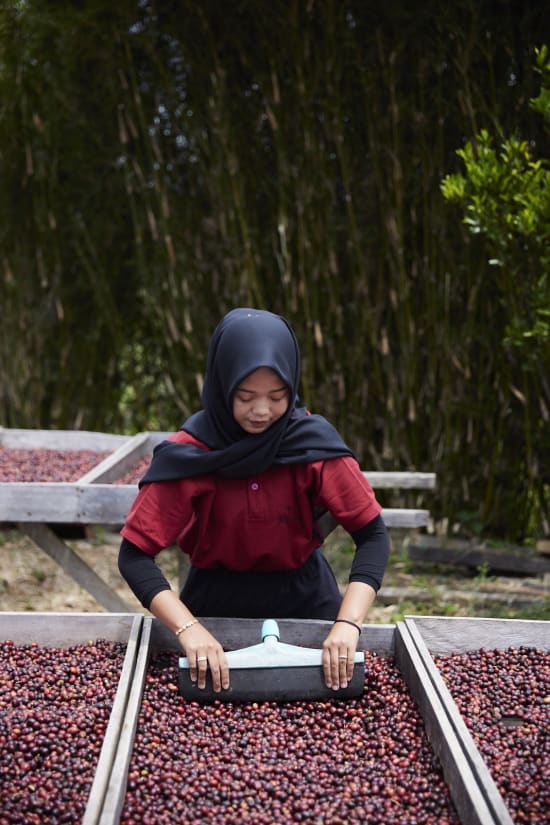
This coffee comes from a small mill in the Pegasing district of Takengon, in Sumatra's coffee-famous Aceh region. The mill is run by Cup of Excellence winner Asman Arianto who, in 2018, formed the Ribang Gayo Musara Cooperative. His goal was to offer competitive prices to help farmers reinvest in their farms and their families. The cooperative currently has over 350 members who deliver cherry to their processing facility in Pantan Musara.
Several years ago, these producers were dislocated from their homes and land in North Sumatra after a long-dormant volcano became active again in 2013. Since then they have rebuilt their lives and farms with a new focus on specialty coffee.
Processing
Indonesia, and this area of Sumatra in particular, is known for producing coffee processed using the wet-hulling method, also known as giling basah. The processing method produces a divisive, signature flavour in coffee that can be described as earthy, savoury and vegetal.
In the 1970s, Japanese interest in Sumatran coffees led to the introduction of the wet-hulled process, a unique style of handling and drying that is largely responsible for its flavor characteristics, and its distinctive greenish-blue hue. The processing method was developed to speed up drying and efficiency in a tropical climate dominated by heavy rain and clouds most of the year. Removing the parchment layer allows the coffee to dry much faster on patios or tarps even in wet conditions.
In Sumatra, coffee farmers typically harvest their coffee and de-pulp it by hand at their farm or home. The coffee then dries for a very short time and is brought either to a coffee marketplace or collection point where the beans are purchased. At this stage the coffee usually has between 30% to 50% moisture content, and the mucilage on the beans isn’t fully removed. The coffee is then combined and hulled (has its parchment layer removed) while it is still in this high-moisture state. The wet coffee takes a lot of power and friction to strip the bean of its parchment layer, so it’s done with specially designed wet-hullers, that are about three times the size of the dry-milling machines you find in other coffee producing countries. After wet-hulling the coffee is dried to the more commonly accepted 11% to 13% moisture in order to prepare it for export.
When he first arrived in Aceh, Asman began working with wet-hulled coffee, but he soon switched to collecting cherry and processing it himself as washed, honeys and naturals. Processing washed coffees—not to mention honeys and naturals—is remarkably difficult in Sumatra’s humid, wet climate. So these coffees are rarely produced in this region. That’s the main reason this coffee stands out. It took a lot of knowledge and effort to make it what it is.
Varieties
Although the coffee in this lot isn’t traceable to specific varieties, it is likely composed of the most common varieties grown in Sumatra, which are Ateng, Bor Bor, Catimor, and Timor hybrids.
Region
Aceh, in northern Sumatra, is an incredible region for coffee production. The average farm is one hectare, 80% of producers within northern Sumatra are women, and 95% of producers are smallholders. The region is diverse, geographically speaking. It is surrounded by beaches with a swampy inland, and the Barisan Mountains make up the inner two-thirds of the area. Coffee is grown on these volcanic mountains amongst the rainforest. One of the notable features of this area is Lake Taboa, the largest volcanic lake in the world.
Importer
This coffee comes to us through Cafe Imports, an importer based in Minneapolis, US, with operations across the coffee growing world. Though we often work with smaller importers who have more personal ties to the origins in which they work, Cafe Imports is a reliable source for high quality beans we wouldn’t otherwise be able to access. They were the source of the first microlot Peruvian coffee we bought to use as a single origin espresso back in the days when we only ever bought Brazil to serve in our flat whites, and now they’ve introduced us to an origin we never thought we’d feature.
A note about packaging
Our coffee comes packaged in beautiful and hard-wearing tins. It is important to keep those beans away from air and light (see our blog post about coffee storage) and we think tins are the very best way of keeping those guys fresh.
Tins can of course be easily recycled (with other metals) but the very best and most environmentally conscious thing to do with them is to refill them. Find out how to refill or dispose of your Steampunk packaging HERE.
Share